A Summer Update from We Make Minnesota
Dear Friends:
It’s been a while since our last update, but there’s lots going on and we are excited to catch you up. For us, summer has been a busy but meaningful time. In July, we welcomed Andrew Ulasich as our Organizing Director and we have been on the road ever since, talking to Minnesotans about the challenges and needs in their workplaces and communities.
So far, we are hearing one resounding message: The status quo is not working. From inaccessible healthcare to underfunded classrooms and scarce resources in social services, we are failing to provide the foundations of strong communities and a high quality of life.
Of course, you will not be surprised to hear that we here at We Make Minnesota believe many of these problem areas require additional funding. But there is a deeper problem as well: We have ceased to envision our shared needs — from education to healthcare to environmental stewardship — as our top priority and the true generator of shared prosperity. What is our answer to the horrors of the opioid epidemic, the climate crisis, or the loss of arts and extracurriculars in our schools?
Our collective challenges require collective solutions, and our failure to provide them is the real reason for the distrust surrounding politics and governance today. There is more to say about the message and the policies we need to meet this moment, but it’s much more impactful coming from the folks living it, and that’s our plan for this summer.
Here is a list of events we have coming up, followed by summaries of where we’ve been so far:
Upcoming Events
We have just started our visits around the state and would love to have you join us at one or more of these events. If you are interested in having us come to your district, community, or workplace for a town hall or round table conversation, let us know! Here are the events currently on the calendar, but more will be added soon.
8/3 St. Paul Town Hall RSVP Here
8/5 Minneapolis Town Hall on childcare RSVP Here
8/12 Coon Rapids Town Hall RSVP Here
8/22 Bemidji Town Hall RSVP Here
9/3 Duluth Town Hall RSVP Here
Recap: July 10 — Mankato Round Table + Bus Tour
On July 10th, we kicked off our summer event series with a round table and rally in Mankato. The table included Rachel, a home-care worker and SEIU member, Chandra, a vocational counselor and president of MAPE Local 1902, Cindy, an academic affairs administrative assistant and president of AFSCME Local 638. We were also joined by Kristen Crowell, from Families over Billionaires, and State Representative Luke Frederick.
Hearing their incredibly heartfelt stories about what underfunding and budget cuts have done to their workplaces and daily lives was very powerful, and I know we will remember that conversation for a long time to come.
In particular, we were struck by the moment when Chandra connected staffing challenges in the state’s Vocational Rehabilitation Services to program cuts at Mankato State, where Cindy works. MAPE workers like Chandra work with the deaf and hard of hearing to build skills and find gainful employment. But that job requires specialization in occupational therapy techniques, American Sign Language, and more. When Mankato State cut related programs due to insufficient funding, it meant fewer qualified candidates for open positions in vocational rehab, which means more deaf Minnesotans going without the assistance they need to join the workforce. When Minnesotans are unable to reach their full potential, we lose out on their valuable contributions and we pay more in social support.
Chandra also shared with us the story of a client she worked with for 10 years who recently started practicing as a dentist. The community gains a much-needed medical professional and the state gains the economic benefits of another wage earner and small business. This is, “we all do better when we all do better” in a nutshell. Unfortunately, the opposite is also true.
You can listen to the full conversation, 3 minute recap, and the story of Rachel, a home care worker and member of SEIU. We will have a lot more clips and videos to share from other parts of the state in the weeks to come!
Immediately following the conversation, we were joined by Families Over Billionaires, as they stopped on their nationwide bus tour. Families Over Billionaires is one of our nationwide partners and advocates for a tax code that makes wealthy individuals and the most profitable corporations pay what they owe so that all of us can thrive.
The Mankato Free Press wrote about the Families Over Billionaires bus tour here.
Recap: July 20 — Rochester Round Table
On July 20th, we hosted a round table in Rochester. In this conversation, we had multiple workers from Rochester public schools, community advocates and faith leaders with ISAIAH, a home care client from SEIU Healthcare, and higher ed staff from both AFSCME and MAPE. State Representatives Tina Liebling and Andy Smith also attended, as well as Simon Glaser (candidate for SD24), Jason Lohmann (candidate for SD20), Heather Holmes (candidate for HD24A), and Steven Holm (candidate for HD20B).
We will have clips and interviews to share soon You can also read the write-up in the Rochester Post Bulletin.
Recap: State Budget Briefing with Ahna Minge
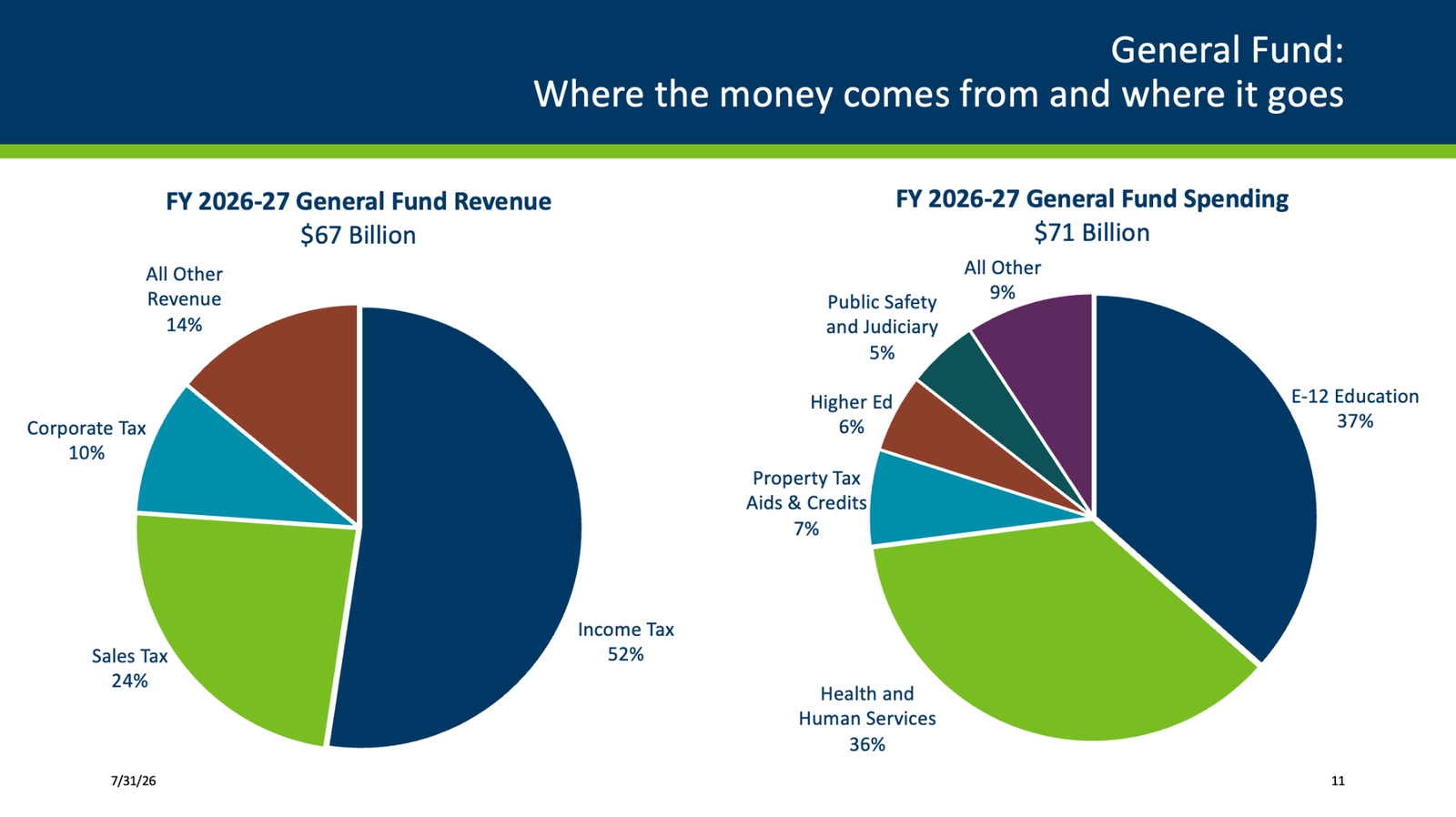
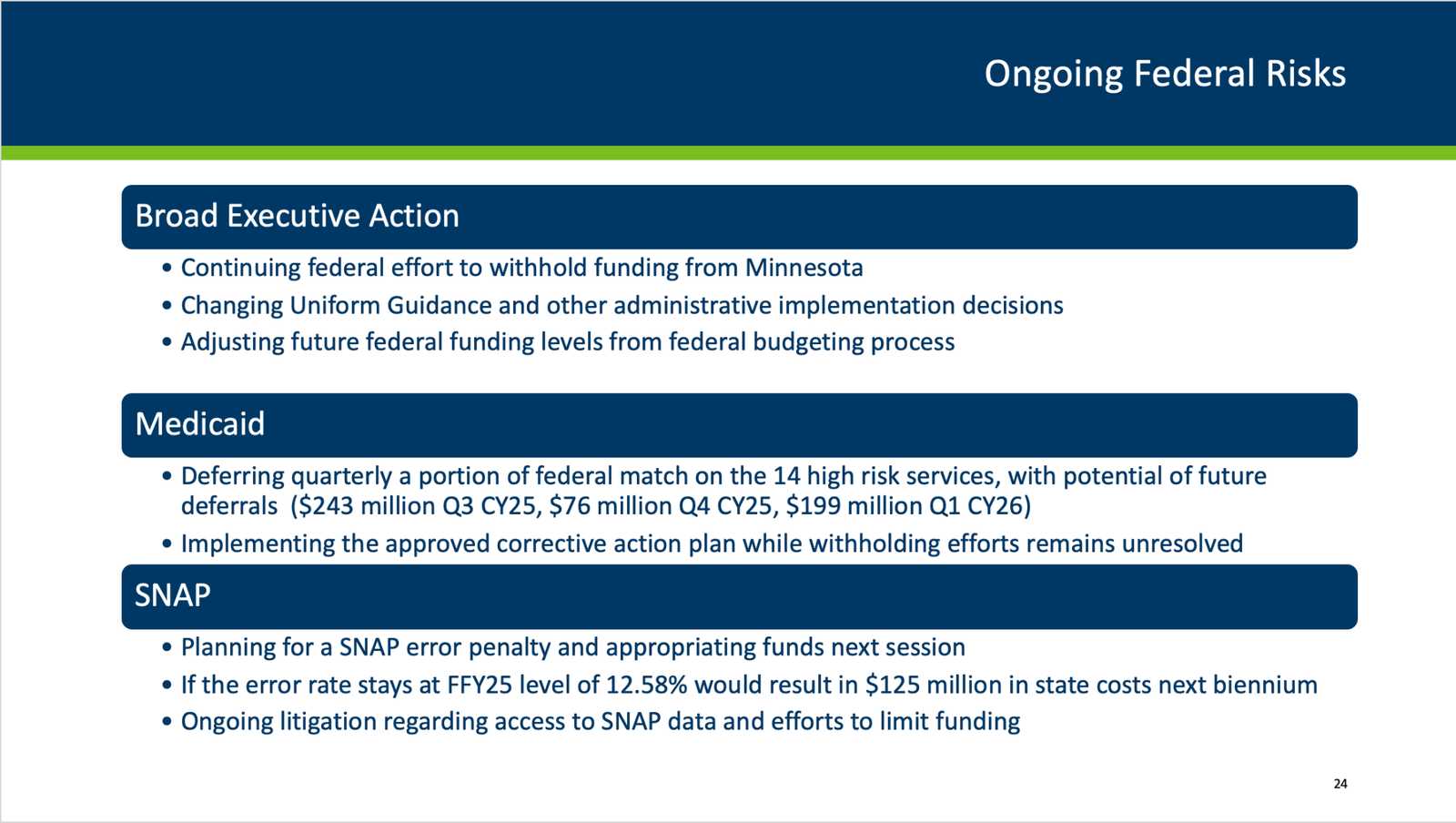
On the policy front we were also excited to convene some coalition partners and legislators for a budget briefing with MMB budget authorities Ahna Minge and Travis Bunch. They provided some very interesting and helpful reminders or where our state budget comes from and where it goes. They also detailed some key challenges facing the state, including a persistent structural imbalance, as well as looming cuts from federal legislation.
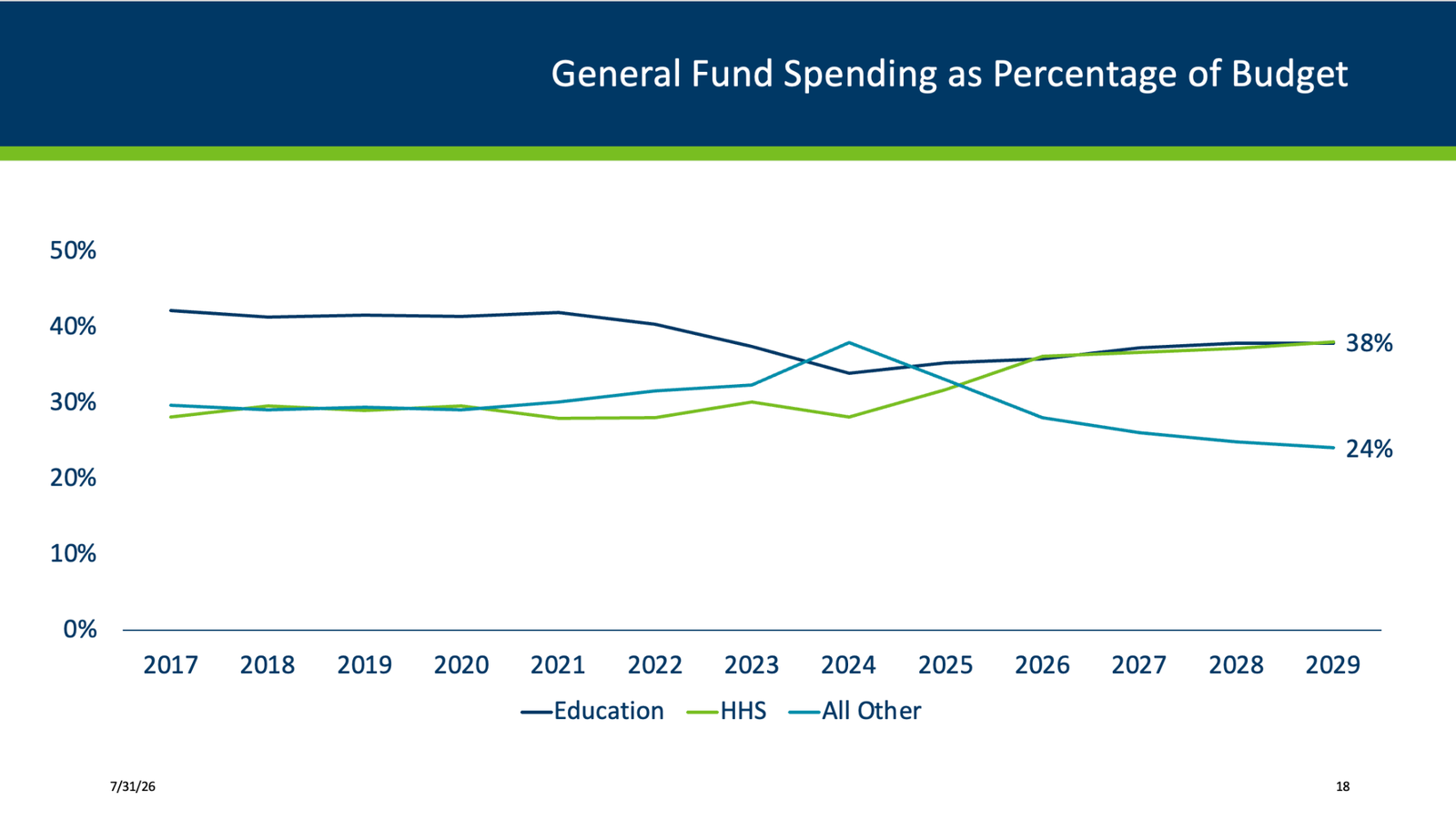
While we cannot share their full slide deck due to size limitations on attachments, we are including a few key images below and would be happy to circulate the full presentation via regular email by request.
What the presentation made clear is that, as Minnesota and the United States grows older, we will need to continue to work hard to find ways to fund the care our communities need while note squeezing out other priorities. This is embodied by the increasing combined share of education and HHS spending. It should be obvious to anyone who wants to live in a functional state, that we can neither neglect the elderly and disabled, nor the education needs of our youth.
Nationwide Tax Updates
Of course, it wouldn’t be a We Make Minnesota newsletter without a little tax news from around the country. In particular, we are tracking developments in a wide range of tax policies seeking to raise more money from the tech industry, which is growing rapidly and generating enormous wealth in the hands of the few, but widely shielded from taxation.
Illinois
In June, Illinois passed a series of new taxes on the digital economy, including taxes on social media, cryptocurrency, prediction markets, and digital advertising. Illinois joins the growing number of states taxing digital advertising, including Utah, Maryland, Washington, Hawaii, and New Mexico. Nationwide online advertising revenue totaled nearly $300 billion in 2025 and is largely untaxed at the state level here in Minnesota.
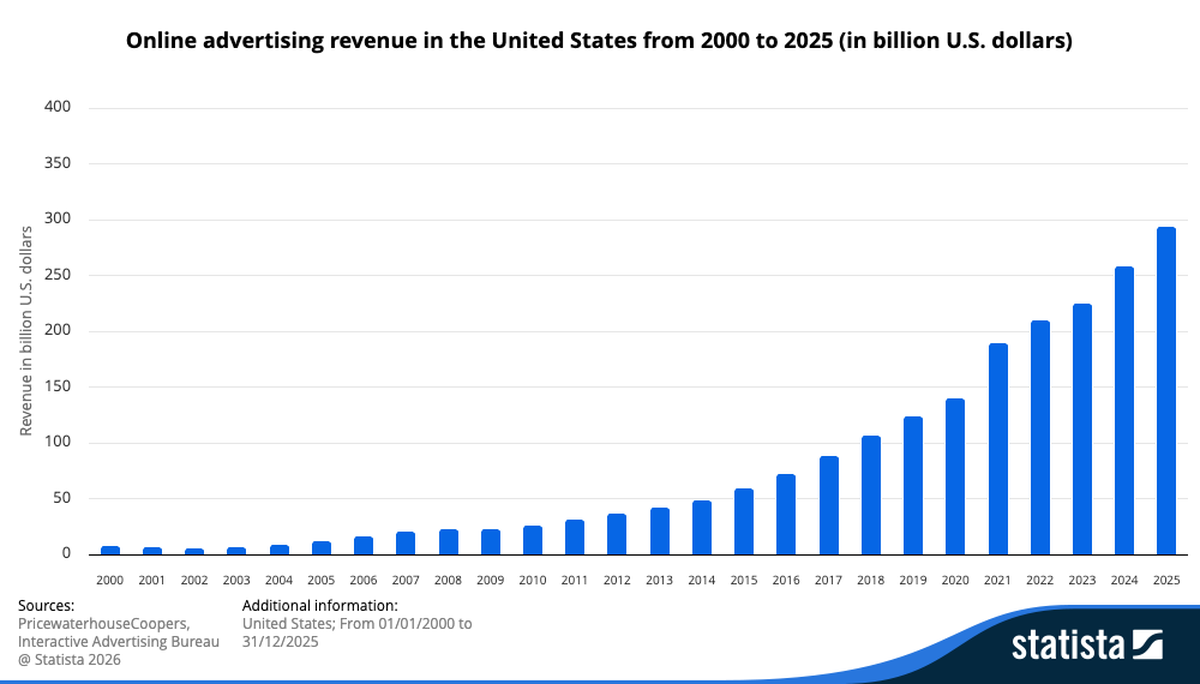
We Make Minnesota supported taxes on advertising services and social media platforms proposed in the legislature last year and will work to pass those into law next session. Both pieces of legislation would be important steps in modernizing our sales tax base to reflect the modern service-based economy and ensure budget stability going forward.
Virginia
The state with the largest number of data centers just passed a tax on the electricity they use. Data centers in Virginia will now be charged 1.1 cents for every kilowatt-hour consumed. To give a sense of scale, a site with a capacity of 100 megawatts would owe approximately $9.6 million each year, and a gigawatt campus would owe $96 million each year. The Virginia law institutes a $600 million cap on collections from this tax. Refunds will be issued to data centers if total collections exceed that amount.
A similar tax passed in Minnesota would not raise as much revenue due to the size difference in the tax base: Virginia has 665 data centers, using 24 terawatt-hours per year, while Minnesota has 75 centers using 1.5 terawatt-hours per year.
As more data centers are being proposed across the state (including in the Star Tribune building), Minnesota should closely examine ways to raise revenue from this growing sector of the economy.
Thanks for reading and have a great weekend!
Eric, Alec, and Andrew