
All Things Public, 5/8: All About HCMC
Legislators, Partners, Allies, and Staff:
As session comes down to the wire, it seems the consensus most urgent priority is Hennepin County Medical Center. The critical safety net hospital is at risk of closure due to large amounts of uncompensated care and impending Medicaid cuts.
There is broad consensus that emergency funds are needed, but the sticky question is how? In this HCMC edition of All Things Public, we share our perspective on the major questions at hand, namely:
What is the need?
What are the options
One-time v. ongoing revenue
Tension between perfect and good
Understanding the causes
Let’s dive in.
What happened?
HCMC has operated with budgetary challenges for several years, with the county taxpayer’s subsidy increasing from $40 million in 2023 to over $100 million in 2025. Now, several factors have created a gap too large to close with the county property tax levy. These factors include:
One-time losses: $115 million in UCare collapse and spend-down of COVID relief money.
Rising Prices: Prices typically increase at roughly double the rate of reimbursements.
Uncompensated Care: $40 million in 2020, growing to $104 million in 2025.
Future Federal Cuts: Cuts in HR-1 are estimated to cost $1.7 billion over the next decade.
Capital Needs: Delayed equipment and facility maintenance can no longer be ignored.
How much funding do they need?
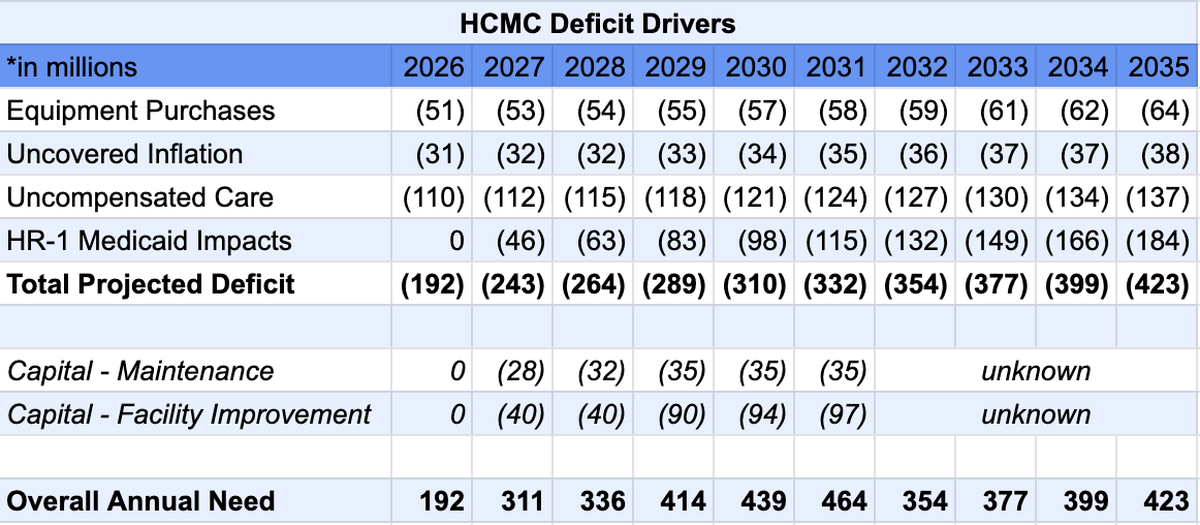
Much of HCMC’s financial instability has been driven by rising uncompensated care costs (charity care and bad debt). The chart below shows that when accounting for equipment purchases, uncovered inflation, and uncompensated care, HCMC’s projected operating shortfall for 2026 is $192 million. This shortfall will continue to grow as the federal Medicaid cuts are implemented.
Policy Options:
Several funding proposals have been debated at the legislature this session. On the House side, HF 4849 would create a standalone 1% Hennepin County sales tax, directing $337 million to HCMC. HF 4841 would expand the current Hennepin County sales tax from 0.15% to 0.75%, generating over $250 million a year. $7 million would go to the Twins for stadium improvements and $4 million to youth sports and libraries, with HCMC receiving the remainder. In addition, the bill provides $150 million in grants to HCMC and $150 million to a statewide hospital stabilization program.
On the Senate side, SF 5052 raises the county sales tax to 0.25%, with $55 million going to HCMC, $9 million to the Twins, and $21 million to North Memorial. SF 4612 includes $150 million of one-time funding for HCMC, as well as a $114.8 million hospital stabilization program, and $30 million for safety net providers and rural EMS.
Other ideas include establishing charity care or uncompensated care funds using the current General Fund surplus and wouldn’t have an ongoing local funding mechanism. Republicans have also suggested using revenue from existing taxes, like the metro county sales tax for transportation.
It appears likely than any sufficient solution will draw on several of these components, but much of We Make Minnesota’s advocacy has focused on the Hennepin County sales tax due to the need for ongoing funding…
Need for ongoing revenue:
One key dynamic of the funding debate has been the question over whether to pass an ongoing tax increase or to use the current General Fund surplus. The final solution will likely involve a mix of General Fund and local sales tax revenue, but we emphasize the local funding because it will be dedicated, guaranteed, and ongoing. That is key for hospital staff.
Staff choose to work at HCMC because of its mission to provide quality healthcare to everyone and understand that it leads to a more challenging work environment. But they also have bills to pay and families to feed. Understandably, the financial instability has caused the resignation rate of HCMC staff to double compared to recent years. It is also costly to replace these employees, with internal documents showing that recruiting and training one nurse costs $75,000.
When staff leave, HCMC loses the capacity to provide the same volume and quality of services, meaning less revenue, which deepens financial instability, which drives more departures. The only way to stop this spiral is to provide long-term funding so workers know the hospital will continue to operate in the years to come.
A one-time grant would not assuage those fears. HCMC also cannot bond against a general fund appropriation for capital improvement projects. The Hennepin County sales tax would provide sustainable funding that the hospital requires for its short and long term needs.
Don’t let the perfect be the enemy of the good
We Make Minnesota has long argued that the most important thing about taxes is the stuff they pay for. Cases like HCMC illustrate why we feel this way.
HCMC treats roughly 115,000 unique patients each year, including almost 95,000 in the emergency department. It provides services that few Minnesota hospitals can replace, and some that no others offer, including the state’s only 24/7 emergency hyperbaric oxygen chamber; one of the nation’s busiest burn units; and the largest emergency department and trauma center in the state, caring for the most critically injured patients in the upper Midwest.
Losing these critical functions would have wide-ranging impacts on patients and hospitals across the state, which must be avoided at all costs. There is a strong argument that these statewide services should be funded with statewide revenue, but the biggest loss would be failing to adequately support the hospital. Here are some thoughts on the most common criticisms of the Hennepin County sales tax option.
Geographic Equity: Because HCMC is a statewide asset that treats patients from across the Midwest, many legislators believe that the solution should require funding from all parts of the state rather than just Hennepin County. This is a valid point, but with very little chance that House Republicans would support a statewide tax increase, it is worth recognizing the upside of a county sales tax.
One advantage is that roughly 24% of the tax would be paid by non-residents who make taxable purchases when visiting the county. It’s not a perfect solution, but is better than relying on local income taxes or property taxes where 100% of the tax is paid by residents.
Regressivity: The distribution of the tax burden is another concern. We Make Minnesota advocates for a balanced tax code capable of funding our public investment needs and ensuring that the wealthy pay their fair share. However, we must not overstate the burden of broad taxes. The highest current sales tax proposal is for an additional $0.75 of tax on every $100 of spending. According to state data, the average tax increase would be about $2.70 per week, with lowest income households paying an additional $1.18 and the highest income households paying an additional $6.49 per week.
Perhaps more importantly, we must also consider the use of the revenue in addition to its source. This chart shows the impact if state sales tax revenue were equally distributed to all households. For example, in 2023, the average household in the lowest income decile paid $1,094 in sales taxes. An equal distribution of all sales tax revenue would send $2,545 to each family, resulting in a net benefit of $1,451. On the other hand, the wealthiest households paid $6,639, meaning they would have a net cost of $4,094.
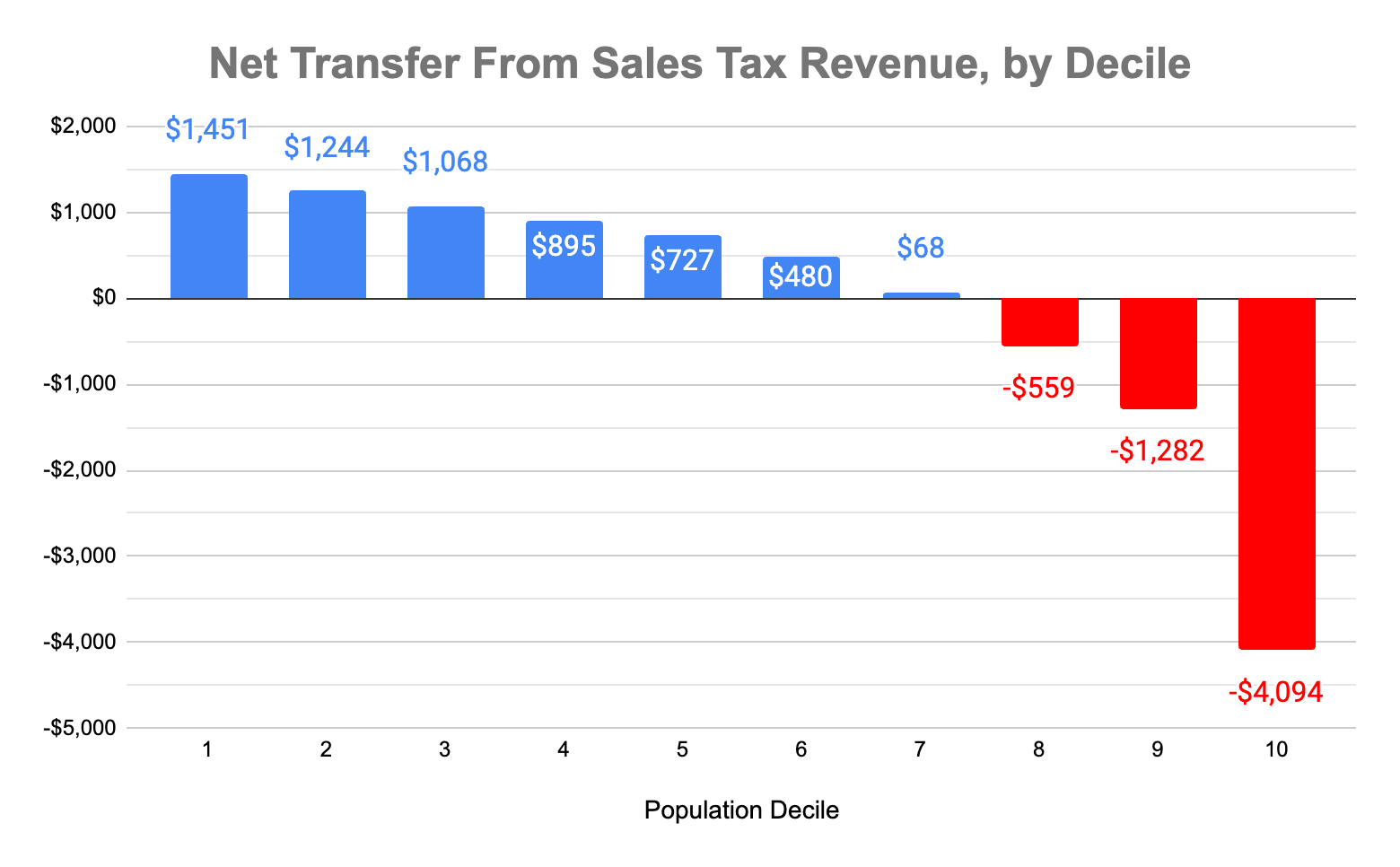
In the case of HCMC, the benefits are almost certainly more favorable to the lower end of the income distribution because of the concentration of the hospital’s services among our lowest-earning neighbors.
Don’t blame the victim (or the heroes):
HCMC is the hospital that treats everyone, regardless of ability to pay. Their patient population is the most complex in the state: 20% experience housing instability, 25% have a substance use disorder, and 25% experience food insecurity. A large majority of patients are on Medicaid, Medicare, or are uninsured, straining the hospital’s finances. Our healthcare system allows private providers to specialize in profitable treatments and leaves the costly care to safety net hospitals like HCMC.
Cutting costs/ increasing efficiency: There has been quite a bit of discussion coming from members of the House GOP caucus about what the hospital has done to lower expenses before the state gives them more funding. Since the beginning of the year, the hospital has cut 100 beds and laid off 100 staff members, paused retirement contributions, cut several programs, and committed to searching for cost-saving and revenue-raising solutions going forward.
Governance: In August of last year, the county commissioners voted to dissolve the hospital board and assume the role themselves. This has not been an ideal situation for anyone, and a priority for many legislators is the establishment of a new board that includes a mix of healthcare finance experts and community members.
But these are not the drivers of the hospital’s financial struggles.
The key point is that HCMC is not in this crisis because of mismanagement, fraud, or waste. It’s mission as our safety net hospital means that they care for the least profitable patients in the healthcare system. They operate on slim margins and cannot continue to absorb these rising costs from uncompensated care and the looming federal Medicaid cuts.
More to come…
Well, that’s probably way more info than you wanted or needed on this beautiful Friday afternoon. Thanks for reading and please feel free to reach out with questions.
Eric and Alec